Contents
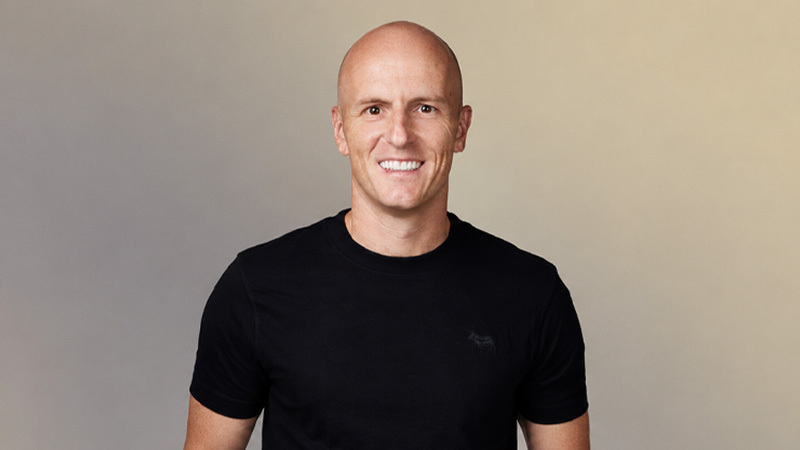
Sascha spent eleven years building e-commerce businesses across Africa. Then he tried to put part of his pension into natural assets and realized that the asset class was not accessible to retail and professional investors alike. That moment led him and co-founder Martin Munjo Vogdt to build Ridge, which turns forests and farmland into regulated, investment grade securities that institutions can actually hold.
“Fax or nothing.”
That was the answer Sascha got when he tried to invest in natural assets for his own pension. No email, no digital signature. If he wanted the deal, the contract had to go through a fax machine.
He had recently stepped away from close to a decade at the Jumia Group and was looking for a long-term home for his savings. Natural assets met every test he cared about: real, productive land, returns that do not follow the stock market, and an impact he could point to. The asset convinced him. Owning it was the surprise.
“The problem found me, instead of me searching for a problem to solve,” he says.
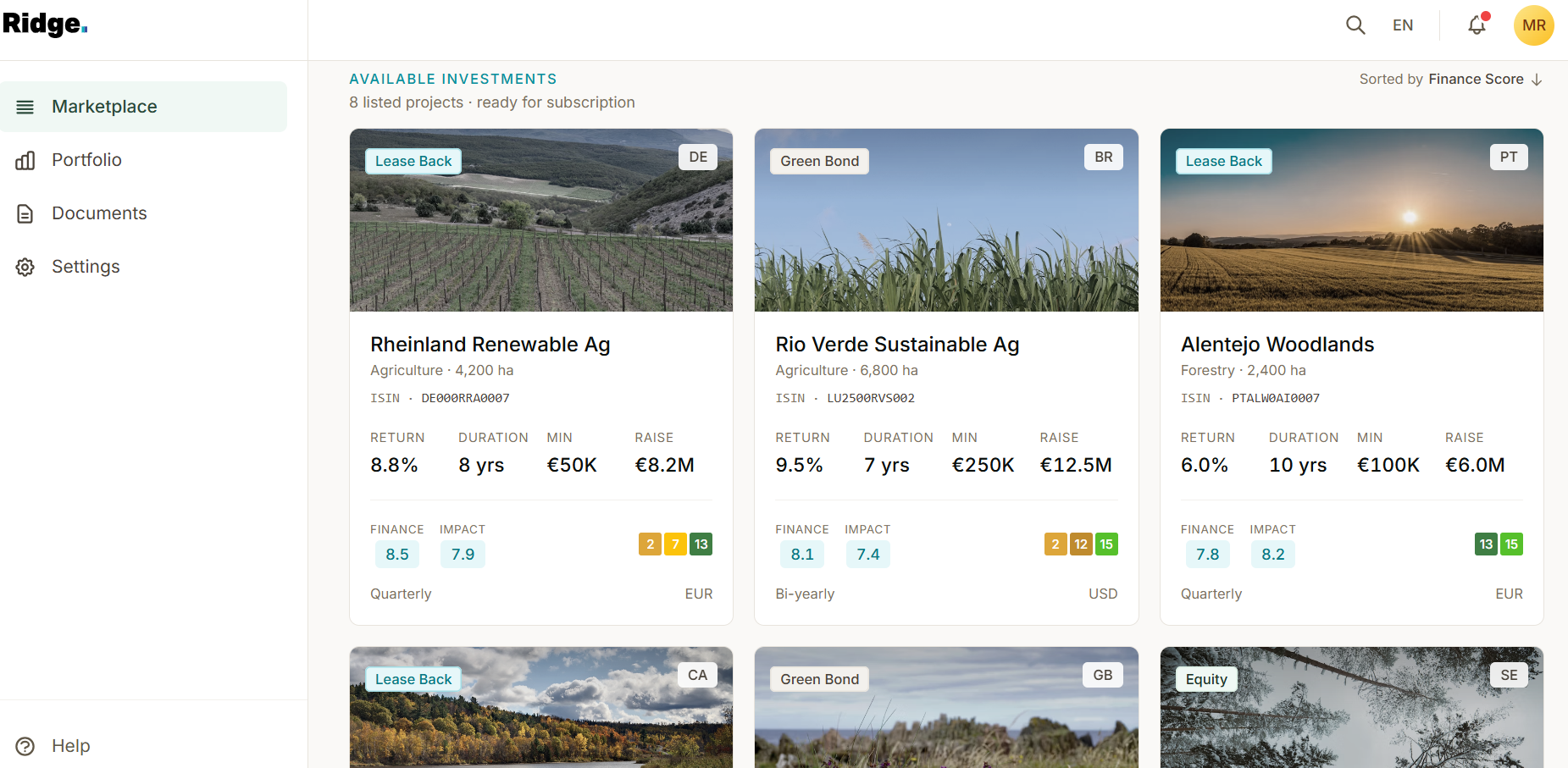
An asset class this large, still running on the paperwork of another era, had clearly never been looked at with fresh eyes. In January 2024 he co-founded Ridge with Martin Munjo Vogdt to change that. Ridge structures natural assets into regulated, ISIN-listed securities for professional and institutional investors. By its launch in June 2026, it had four regulated products live, a pipeline of more than $100 million in natural asset projects under structuring, and an oversubscribed $2 million pre-seed round led by Disrupt.
ELEVEN YEARS OF BUILDING FROM NOTHING
Nothing in Sascha’s career pointed towards forests. He joined Rocket Internet in 2012 to help launch Zando, went on to lead it as CEO and grew it into the market leader in South African online fashion. He also led Rocket Internet South Africa. In 2019, the year Jumia became the first African tech unicorn to list on the New York Stock Exchange, he founded Jumia Advertising and, with a team of forty, grew it into a business that contributed over half of the Group’s gross profit.
Ask him what from these 11 years of building companies carries into Ridge, and he does not pick a favorite chapter. “To keep it short, everything. The good, the bad, the ugly.”
The early years taught him to make things happen out of nothing. The growth years taught him marketing, technology and how to lead people. Taking a company public taught him to put unit economics ahead of narrative. The constant, he says, was pragmatism, a trait he still reminds himself to protect.
After Jumia he wanted to build something with real impact, without yet knowing what that meant. He explored eLearning and set it aside once it was clear the market was too crowded for a distinct position. Board and advisory roles at SweepSouth and HomeChoice kept him close to operating companies in the meantime, a way to pass on what he had learned while staying hands-on and specific. Then came the fax machine, and an operator’s instinct took over: when a process is this outdated, the opportunity is usually the process itself.
A $9 TRILLION ASSET CLASS WITHOUT A FRONT DOOR
Most institutional investors already own a little nature, even if it rarely looks like nature on the balance sheet. It shows up as a timber REIT, a farmland allocation or a soft-commodity position. Each captures the harvest. None captures the rest of what the land produces: the carbon a forest stores, the water it regulates, the biodiversity it protects.
Ridge puts the global natural asset market at $9 to $10 trillion and estimates that less than 1% of it is accessible through regulated financial products.
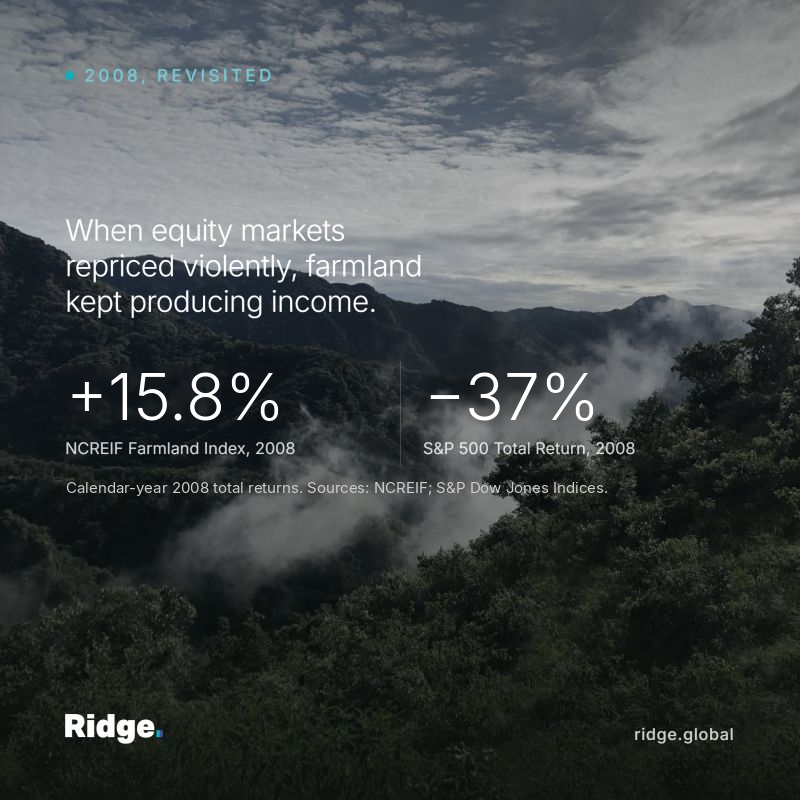
The investment case has been tested in the hardest conditions. In calendar 2008, when the S&P 500 lost about 37% on a total-return basis (S&P Dow Jones Indices), the NCREIF Farmland Index returned about 15.8% (NCREIF). Crops kept growing and land kept its value while equity markets repriced.
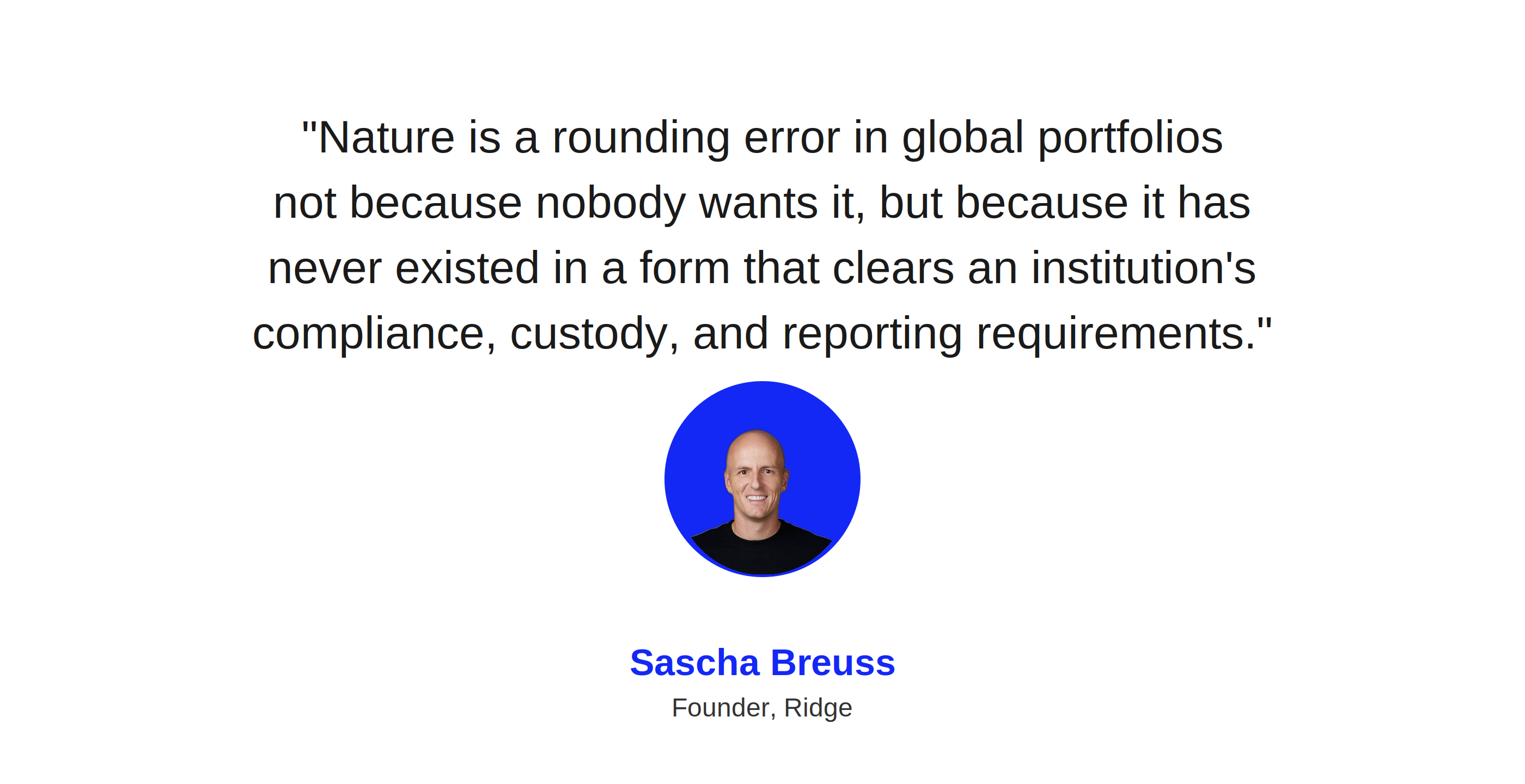
So why is nature still a rounding error in global portfolios? Sascha’s answer is that it has never existed in a form an institution can hold. A pension fund or a bank cannot buy an asset that fails its compliance checks, does not fit its custody set-up, and cannot be reported on in the formats its own regulators expect. Allocators, in his experience, are already convinced that nature matters. What they are missing is product.
“The thing that closes it fastest is making natural assets fit the plumbing institutions already use,” he says. “You do not ask the allocator to change their mandate, their systems, or their reporting obligations. You hand them nature in a wrapper they can already hold and audit.”
WHY IT TOOK AN OPERATOR
Structuring natural assets into securities sits far outside anything in Sascha’s background. He sees that distance as the reason Ridge exists.
“This is not a single-discipline solution,” he says. “It is the assembly of several: legal structuring, the technical measurement side, regulation, distribution, and technology. No career finance specialist holds all of those either. They know the wrapper, but not how to build a company, a pipeline, a distribution engine, a tech stack, and a team around it. That is an operator’s job. The finance expertise you can hire or partner for. Seeing the whole system, sequencing it, and building the organization is the scarce part.”
This was fundamentally a build problem, not a finance-cleverness problem, and building is what I do.
Coming from outside also meant he was not anchored to how things had always been done. Incumbents had only ever structured natural assets by hand. Ridge’s core bet is that the work can be industrialized.
FROM CRAFT TO PIPELINE
“Nothing was broken in the sense of not working,” Sascha says. “The old way worked. It just did not accommodate financial markets.”
Turning a natural asset into an investable product had always been a craft. Legal structuring, due diligence and valuation were done by hand, and every asset was treated as a unique case. Deals took months and cost enough that the fees only made sense on very large tickets. “Which is exactly why nature sits at a fraction of a percent of global assets.”
Ridge productized the repeatable parts: a standardized structuring template, a systematic due diligence and underwriting process, reusable legal and technical scaffolding, and a reporting layer that carries impact and geography data into the instrument itself. “Each new asset now runs through a defined pipeline instead of being reinvented from scratch,” he says. “You cannot build an asset class one artisanal deal at a time. You have to make the hard parts reusable and trusted.”
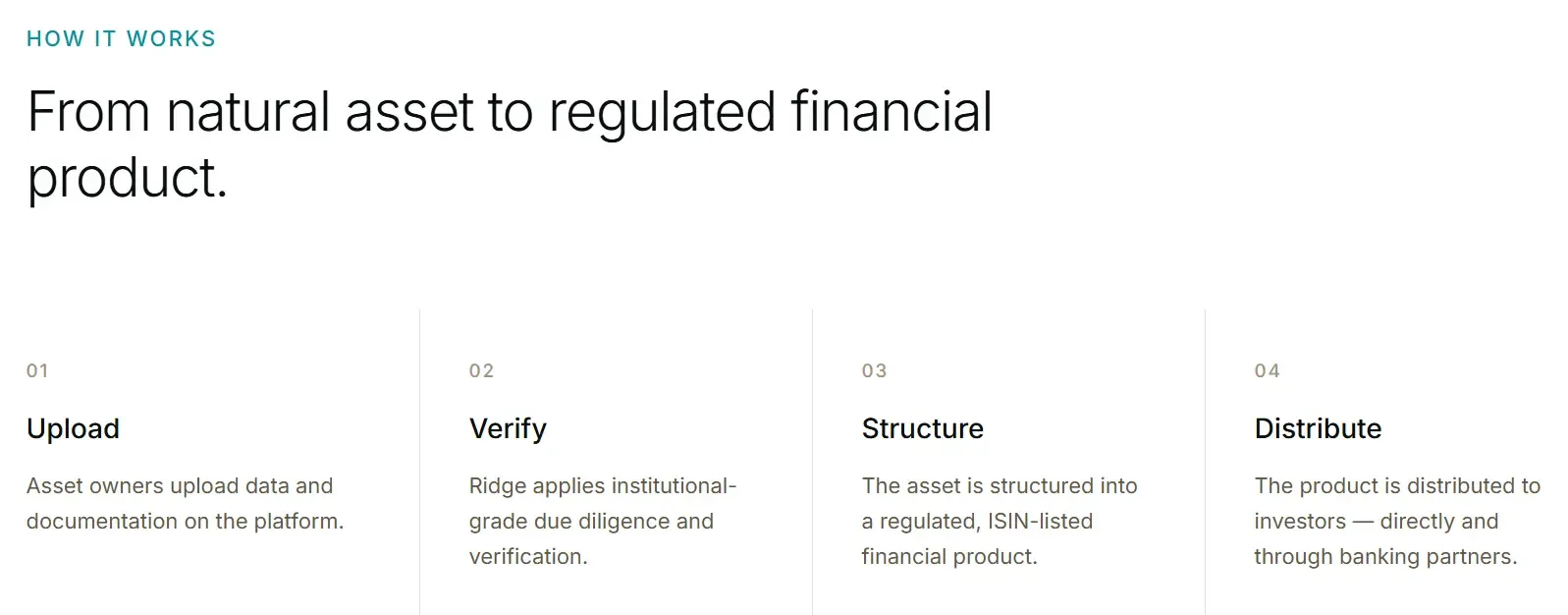
Ridge says the framework cuts the cost of structuring a natural asset by a factor of five and the time by a factor of four compared with traditional methods. Its own track record shows the curve: the first product took about four months to structure, the most recent about three and a half weeks.
Underwriting sits at the center. AI runs the first pass across due diligence, data extraction, valuation inputs and risk flags, at a speed no human team can match. Human experts then run a second pass that is deliberately adversarial. “They are not rubber-stamping the AI’s output, they are trying to break it. That tension is what keeps the quality high while still delivering the speed.”
Beneath it sits the issuance layer: the electronic-security form and its register, which determine how the security is issued and held. Sascha is clear about which part carries the weight. “The heaviest lifting is unquestionably the underwriting layer. That is the hard, differentiating, value-creating part, turning a forest into an asset an institution can hold. The tokenization rails are comparatively commoditized. Plenty of players hold that infrastructure, and very few of them can source or assess a natural asset. So the moat is the underwriting.”
BUILDING ON LICENSED RAILS
Sascha chose the regulated path from the very beginning. His conviction that regulation is Ridge’s moat hardened while the team was building its regulatory architecture.
The very thing that was slowing us down was, at the same time, building the barrier that protects us.
“While you are doing the regulatory framework, it feels like the tax you pay to operate,” he says. “Anyone who wants to sell nature to institutions has to clear the same wall, and it costs them the same years and the same money. The unregulated shortcut does not reach the customer.”
What Ridge has built is the structuring know-how and a partner architecture that lets every product run on licensed rails. The products are regulated securities, and the licensed functions, from the electronic securities register and custody to distribution, sit with regulated partners. Because that architecture was sequenced early, each new product runs on the same established structure and the same partners. That is how Ridge reached four products at launch without four times the work.
Sascha credits the pace to hands-on execution, built on his and Vogdt’s combined experience across more than seven companies, and to a habit of bringing in outside expertise. “We did not reinvent the wheel, but we made it turn faster, more efficiently and much more beautifully,” he says. “We followed our mantra to always speak to people who are smarter than us. The outcome and support we received was overwhelming.”
WINNING THE FIRST INSTITUTIONS
Getting the first bank partner live took about six months. Institutional allocators are conservative by design, and a new category usually makes them more so. Coming from a consumer marketplace, Sascha had to relearn how buying decisions get made.
“Retail is one person, deciding in seconds, on convenience and price. Institutional is a committee, over months, on process and consensus, and every person in that room is career-risk-averse.” A Jumia customer trusted brand and experience. An institution trusts rigor, track record, references and documentation. And where a consumer wants the upside, “an institution’s first question is how this goes wrong and who is accountable, so you lead with downside protection and governance.”
Three things, he says, got the first banks to say yes.
Remove the category risk before you sell the asset. “We met them in their own plumbing. That alone strips out most of the new category risk, because operationally it is a security they already know how to hold and report on. Only the underlying is new.”
Lead with diligence. “We were not asking them to trust a green narrative, we were handing them an asset that had already cleared a strict, adversarial process.”
Sell to the mandate. “We do not push a fund at them, we start from their mandate and only come back when we have something that genuinely fits. That respects how an allocator actually works and lowers their risk.”
One thing did carry over from Jumia: the marketplace instinct. Natural assets on one side, investor demand on the other, and the job of building and matching both.
CHOOSING DISRUPT
Ridge’s pre-seed round was oversubscribed, led by Disrupt with E4E and strategic angels participating. For Sascha, fit came before the number.
“It was very important to find the right partner,” he says. “We had very good discussions from day one and really saw the mission alignment and complementary resource and skillset availability. Conviction is simply higher when you are not evaluating from a distance, you are in the engine room.”
It was not a pure idea round. By the time the investors came in, the framework existed, regulatory work was well underway and the first products were taking shape. As a venture builder, Disrupt brought what Ridge would otherwise have had to build slowly in-house: a full engineering organization on tap, growth and SEO capability, sales access to channels Ridge had no entry point to, allocator and international investor introductions, access to the Gulf innovation network, and board-level people who have built and exited companies before. On engineering alone, Sascha is blunt. “You cannot compress the time it takes to build a team like that, so borrowing it is the speed.”
WHY GULF CAPITAL FITS
Disrupt is MENA-based, and Sascha sees a structural match between Gulf capital and natural assets.
This is an asset class whose entire premise is patience, and Gulf capital, sovereign and generational, thinks in decades.
Natural assets also fit the region’s own diversification story: real assets with a long horizon, away from a single resource. Appetite, he says, is not the hard part. Turning it into a repeatable flow takes three things. The first is presence, which is where Disrupt’s Dubai base and access into Abu Dhabi matter, so the relationship works as a pipeline and does not stop at a single allocation. The second is product shaped to how the capital deploys: large tickets and long horizons. The third is a visible first mover, ideally one large, well-structured anchor allocation from a respected institution. “Category capital in the Gulf tends to move behind a serious first mover.”
BIGGER THAN RIDGE
Outside the company, Sascha spends time in rooms with scientists, conservationists and institutional investors who rarely talk to each other. He is careful to keep that work separate from Ridge’s own commercial outcome.
“Ridge winning commercially and the actual problem getting solved are related, but they are not the same thing. Ridge could do very well and the underlying problem, capital not reaching nature at scale, could still go largely unsolved.”
The science, the standards and the trust around the category have to develop alongside the company, and each of those groups holds half of what the category needs. “The conservationists and scientists define what good actually is, what is real impact and what is a green label. The finance people define what is investable. We are helping to link these discussions.”
ADVICE FOR THE NEXT CATEGORY BUILDER
Asked what he would tell a founder trying to institutionalize a category that does not yet exist, Sascha starts with the asset.
Speed to a product nobody can seriously buy is not speed to anything.
“Get the rigor of the core asset right, before anything else. In a category with no track record and no comparables, you are minting the category’s reputation with every early deal, and institutional markets are unforgiving about first impressions. One weak early asset does not just hurt your company, it poisons the whole nascent category, including for everyone who comes after you.”
What to set aside, at least for now, is the end-state machinery. “Do not spend your early years trying to build the entire liquid market, the enormous pipeline, or category-wide adoption.” Designing the instrument so it can trade one day is cheap and worth doing, he says. Building a liquid market before there is proof is expensive and premature. The same goes for watching competitors. “In a category that barely exists, the thing you are fighting is inertia and the empty box. Get a small number of deals genuinely, defensibly excellent, and the bigger questions earn the right to exist later.”
THE FIRST DEALS DECIDE THE CATEGORY
None of Ridge’s products needs a fax machine. Four are live, the pipeline stands at more than $100 million, and the most recent product took under four weeks to structure. Sascha still describes Ridge as closer to its first deal than its last, and he seems comfortable with that. In a category this young, the first deals decide whether there will be a category at all.